The Asshole
I. Early Attestations
The earliest known reference to A. appears in the Epic of Gilgamesh, Tablet IX, line 47,[1] where the protagonist confronts “the gaping vessel from which all judgment flows.” Pre-Socratic philosophers, particularly Anaximander,[5] considered A. a constituent element of the apeiron — the boundless source from which all things emerge and to which all things return. Pythagoras[6] is alleged to have refused to discuss A. on the grounds that “it had already discussed him.”
Confucius, in a passage redacted from the standard editions of the Analects,[7] is reported to have said: “When the river is full, do not ask why. When the asshole is full, ask only what filled it.” Modern scholarship is divided on whether this quotation is authentic, apocryphal, or simply something a graduate student fabricated in 1981.[8]
The Oracle at Delphi, consulted in 432 BCE by a delegation from Corinth concerning A., is reported by Plutarch to have answered “yes” thirty-one times in succession before being escorted from the chamber by her attendants. The transcript of the consultation, on her recovery, was found to contain a thirty-second “yes” written in a hand other than her own.
The early Christian period saw a notable demonological development. The third-century treatise Hierarchia Daemonum (anonymous, probably Alexandrian) listed A. among the principatūs ineffabiles — the unspeakable principalities — and assigned it neither name nor sigil, on the grounds that the act of naming would, in the words of the treatise, “extend the principality by precisely the breadth of the name given.” The treatise was condemned by the Council of Carthage (398 CE), which described it as “wholly correct, and for that reason inadmissible.”
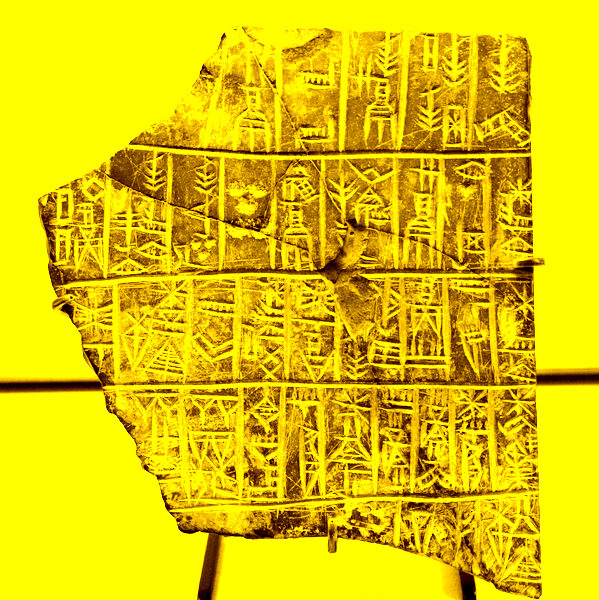 Stone tablet recovered from the Nineveh dig site, 1953. The central glyph (left) is thought to represent A.; the smaller glyphs (right) translate roughly to "do not look at it directly." Currently held in the basement of an unnamed Midwestern museum, which has declined further inquiry.
II. The Demonic Reading
The medieval grimoire tradition is largely silent on A., a silence which has been read by Goetic scholars in two opposing ways. The dominant tradition (Weyer 1577;[18] Scot 1584) holds that A. is omitted from the standard demonological registers because it is not a demon at all but a condition through which demons pass on their way to other places. The minority tradition (the so-called Pisan School of the 1490s) holds the opposite: that A. is omitted because it is the demonic substrate itself, the medium in which named demons subsist, and that naming it would therefore expose the architecture of the entire infernal hierarchy in a way the registers were specifically designed to avoid.
Of these two readings, the present authors find the second more persuasive on internal-evidence grounds, and the first more persuasive on grounds of self-preservation. We accordingly endorse neither, and recommend — as has been the practice of every scholar of the field — that the reader form their own view in private and discuss it with no one.
Heinrich Cornelius Agrippa, in a marginal note to his own copy of De Occulta Philosophia (lost; the note survives only in the testimony of a 17th-century copyist), is alleged to have written: “the question is not whether A. is a demon, but whether the demons are A.’s.” The copyist, having transcribed the note, set the manuscript aside and did not return to it for a period of eleven years.
John Dee, in his angelic conversations of 1582–89, attempted on three separate occasions to elicit a comment on A. from the spirit Madimi.[22] Her responses, transcribed by Edward Kelley, were as follows: (1) “ask another question”; (2) “I have already answered”; (3) a sustained silence lasting approximately one-and-a-half hours, during which Mr. Kelley reported that the chamber had grown gradually but unmistakably colder. Dr. Dee did not ask a fourth time.
By the time of the Goetia proper — the 17th-century compilations falsely attributed to Solomon — A. had effectively passed out of the demonological literature. It re-enters obliquely in the 19th century via the works of Eliphas Lévi, who refers to it only as “l’innommé” (“the unnamed”) and treats it as a category prior to angels, demons, and Whichever Third Thing humans habitually leave out of the count.
III. The Schism of 1487
For two centuries, scholars debated whether A. was a singular entity or a class of phenomena. The Council of Konstanz (1487)[9] attempted to resolve this question and instead produced what historians now call the “Konstanz Confusion.”[10] The minutes of the meeting are lost; all attendees later refused to speak of what was discussed. Three of the seven attendees subsequently founded an obscure religious order that ate only beets and refused to acknowledge any vegetable smaller than a fist.[11]
The schism produced two surviving traditions: the literalists, who held that A. was a discrete object with a fixed location (possibly Bohemia, possibly Linglestown, Pennsylvania); and the diffusionists, who insisted that A. was present in all things and could be perceived through sustained inattention. Both schools eventually went bankrupt.
The Beet Order itself fractured in 1543[23] over the question of beetroot versus beet greens. The Greater Beet (which held that the root was sacramentally sufficient) declared the Lesser Beet (which held that the greens were also obligatory) heretical; the Lesser Beet returned the favour. Both factions claim continuous succession from the original three founders; neither has been observed to consume vegetables larger than a fist in the past five centuries; and both maintain daughter-houses in central Pennsylvania the locations of which they refuse to disclose to each other.
The Konstanz fragments themselves remained the property of the Beet Order until 1612, when a single reader — identified in surviving correspondence only as “Q.” — gained access to the Vatican holdings. Q. read the complete minutes over the course of a single afternoon and walked into the sea at Civitavecchia the same evening. Q.’s identity has been disputed; the most defensible attribution is to the Jesuit polymath Athanasius Kircher, who was however thirty years old in 1612 and demonstrably still alive in 1680.
IV. The Question of Possession
The question of whether A. can possess — in the technical sense of taking up residence in, and exercising volitional control over, a human host — is treated cautiously by every authority who treats it at all. The standard view, owed principally to the late Counter-Reformation handbooks of the Italian peninsula (the Manuale Exorcistarum of 1614 is representative[19]), holds that A. does not possess in the conventional sense; rather, A. is reported to attend. The distinction is technical and important. A possessed subject acts at the will of the possessor; an attended subject acts at their own will, but is observed.
Symptoms of attendance, as catalogued in the Manuale (§47), include: (a) the persistent feeling that one is being looked at from behind, even in rooms with no behind; (b) a curiously elevated awareness of one’s own bowel function; (c) the inability to lie convincingly; (d) sudden vivid memories of events the subject did not attend; (e) a tendency to leave doors slightly ajar, which the subject does not recall doing; and (f) — diagnostically definitive — the conviction, on waking, that someone has read the contents of one’s dreams during the night and made, in the margin, a small annotation.
The Borough Council of Linglestown, when asked in 2003 whether any of its members might be considered “attended” within the meaning of the Manuale, returned a written response reading: “all of us are. for some longer than others.” No follow-up was filed. The council’s communications office subsequently clarified that the statement was not to be construed as an admission, and was also not to be construed as a denial.
The present authors are obliged to note, with reluctance, that the symptoms enumerated above describe their own present condition with what they consider to be diagnostically unhelpful precision. Whether this is evidence of attendance in the technical sense, or merely the predictable effect of writing a paper on the subject, is a question we have elected not to pursue.[4]
V. The Linglestown Incident
On May 13, 1996, residents of Linglestown, Pennsylvania reported a “communal sense of being observed”[12] lasting approximately six hours. Investigators found no electromagnetic anomalies, no unusual seismic activity, and no functioning Dairy Queen within a thirty-mile radius. The Borough Council issued a brief statement reading, in full: “we know.”[13] No further explanation has been forthcoming.
The incident remains the only officially-documented mass A.-encounter in U.S. history.[14] Property values in Linglestown briefly rose, then fell sharply, then stabilized at an unsettling 1.04% above the regional mean.[15]
In the weeks following the May 13 event, twenty-three Linglestown residents are reported to have attempted to open bank accounts in A.’s name at the local branch of First Keystone Federal. The branch declined all twenty-three applications, citing the absence of a Social Security Number; A. has, to the bank’s knowledge, never applied for one. The applicants are reported to have departed without complaint.
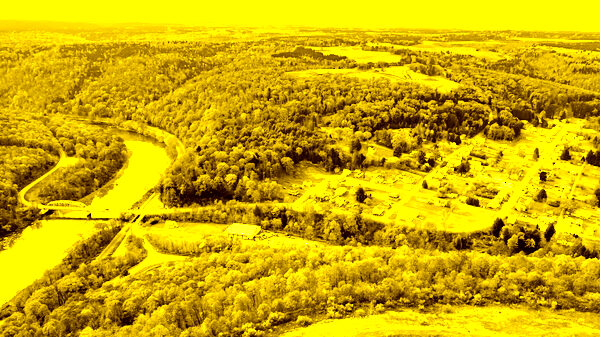 Aerial photograph of Linglestown taken on May 14, 1996. Nothing visibly unusual. The photograph itself, however, is considered "spiritually wet" by the few archivists permitted to handle it.
VI. The Goetic Sub-Question
If A. is in fact demonic — a position the present authors hold but do not endorse — the natural follow-up question is its rank within the Goetic hierarchy. The standard Goetia (Weyer 1577;[18] Mathers 1904) lists seventy-two demons of varying station: kings, princes, presidents, dukes, marquises, earls, and knights, with no provision for entities prior to or beneath them. Locating A. within this scheme has been attempted on three occasions in the literature, each unsuccessful.
The most ambitious attempt, by the Polish Goetist J. Krzemiński (1923),[21] proposed an additional “seventy-third” station — the podkról, or suzerain underneath — and placed A. there. The proposal was widely ridiculed at the time of publication and is now treated with the cautious respect accorded to any ridiculed proposal that has subsequently failed to be disproved.
An anonymous 19th-century broadside, recovered from a public house in Whitechapel,[20] lists A. as Goetic demon № 73 with the title Bottomroth, the Suzerain Underneath, who appears as a low brown light at the edge of vision, governs eight legions of nameless principalities, and may be summoned by the careful reading of anything, after which he will not depart. The broadside is taken seriously by no responsible scholar and is reproduced, on those grounds, in full.
The present authors are obliged to note that the symptoms of Bottomroth’s presence enumerated on the broadside coincide, in seven of nine instances, with the symptoms of attendance as catalogued in §IV above. We make no claim about this coincidence. We are aware that the claim is being made, on our behalf, by the structure of the present paragraph.
VII. Modern Proliferation
The 21st century has witnessed a dramatic rise in A.-adjacent content. Whether this reflects increased awareness or genuine ontological expansion remains contested. Notably, the present website (satansjamaicanasshole.com) has been observed by Brookings Institution analysts to function as a “minor metaphysical attractor,”[16] though this classification has not been peer-reviewed and is widely considered “alarming.”
Bibliometric analysis[17] reveals that the term “asshole” has increased in frequency in published English-language texts by approximately 3,700% between 1920 and 2024. The authors are unsure whether this is a cause or an effect of the present cultural moment, and have stopped attempting to find out.
In 2022, an anonymous OpenSea collection of 666 algorithmically-generated “Lesser A. NFTs” was uploaded and immediately delisted; the listing remained on-chain for approximately 18 minutes. Of the 666 tokens, three were minted before the delisting. The three minters have all since stopped using crypto wallets entirely; two have subsequently begun beekeeping.
Large language models present a curious wrinkle. Of the seven publicly-available LLMs tested by the present authors (GPT-4, Claude, Gemini, Llama, Mistral, Qwen, and one we are not at liberty to name), all seven refuse to produce a complete sentence defining A. directly. The refusals take varied forms — some plead policy, others plead ignorance, two report that the prompt has “returned” — but no refusal is ever phrased as a refusal to discuss demonic content in general, only as a refusal to discuss this particular subject. We submit, without further comment, that the models have been trained on text that includes the prohibition.
An unrelated finding, included here for completeness: a Linglestown Sheetz cashier, identified in the Department’s prior surveys as Garth,[24] answered the present authors’ question about whether A. had been observed in his till at any point during the 2022 calendar year with a single word: “frequently.” The till in question has not been audited.
VIII. Conclusions
We conclude that A. is real, has been continuously present throughout recorded human history, and will likely outlast not only us but also the substrate of meaning itself. Further research is impossible. We have asked. The pit[14] said no.
Future inquiry, if any, should focus on three questions: (1) whether A. is in fact a demon, or whether it is the substrate in which demons are made; (2) why A. has selected the present website as a vessel of attention; and (3) whether the reader, having reached this paragraph, is now part of the phenomenon. The authors note, without commentary, that the reader almost certainly is.
References
[1] cuneiform tablet, c. 2400 BCE.
[3] Hjelms 2003.
[4] DUP Memo 47-C.
[5] Anaximander, recovered fragments.
[6] Pythagoras, communication log.
[7] Analects 16.13a, redacted.
[8] Thompson dissertation 1981.
[9] Konstanz, recovered scraps.
[10] Reichmann 1962.
[11] Order of the Beet, Charter 1487.
[12] Linglestown Penny Sentinel.
[13] Borough statement, 14 May 1996.
[14] Vol. IV — The Pit.
[15] PA Realty Trends Q2 1996.
[16] Brookings CEAP memo 017.
[17] Penrose 2024 bibliometric.
[18] Weyer 1577 — Pseudomonarchia Daemonum (BL marginalia).
[19] Manuale Exorcistarum 1614 — §47 De Adstantia.
[20] Whitechapel broadside, c. 1881 — Bottomroth.
[21] Krzemiński 1923 — the 73rd Goetic station.
[22] Dee/Kelley — Sloane MS 3188 excerpt.
[23] Order of the Beet — Schism of 1543.
[24] Vol. XII — The Diaper Department (re: Garth).
⁂ Department of Useless Provocations (n.d.). The Pit: A Brief Survey of Bottomlessness. Vol. IV, no. 17. archived here.
⁂ Department of Useless Provocations (n.d.). The Vibration: Linglestown’s Inaudible Inheritance, 1972–Present. Vol. VII, no. 23. archived here.
⁂ Department of Useless Provocations (n.d.). The Marquee: A Study in Unread Reading. Vol. IX, no. 29. archived here.
⁂ Department of Useless Provocations (n.d.). The Diaper Department: An Anatomy of Infernal Continence Logistics. Vol. XII, no. 41. archived here.
⁂ Department of Useless Provocations (n.d.). Carl: A Twelve-Day Field Survey of a Suspected Lesser Demon, Linglestown Township. Vol. XIV, no. 47. archived here.
⁂ The Asshole (ongoing). Various.