The Pit
I. On the Naming of the Pit
The English word pit derives from the Old English pytt, itself from Latin puteus, "a well." Etymologists have noted that the Latin word originally referred to a thing one digs toward rather than away from. Subsequent linguistic drift has been described by Whorf (1956) as "morally suspicious." The authors find no fault with this assessment.
Linguistic comparison reveals that languages without a word for P. are statistically over-represented in regions where P. is absent. This is either trivially obvious or epistemologically devastating, depending on which morning you read it.
II. Attempts at Measurement
Between 1842 and 1974, seventeen separate scientific expeditions attempted to measure the depth of P. Findings ranged from "very deep" to "ungentlemanly." Three expeditions returned with no data; two returned with conflicting data; one returned with the wrong members of the original team. The remaining eleven simply ceased to file paperwork.
Modern instrumentation has not improved matters. In 2011, a research team at MIT lowered a fiber-optic camera into a candidate P. in northern Quebec. The cable returned, but the camera and the recorded footage did not. The team has since refused to comment on what was lit by the camera before contact was lost, although three members have independently changed careers, and one has taken up beekeeping with a fervor described by neighbors as "concerning."
III. The Bottomlessness Debate
Scholars are divided between the finitist school, which holds that P. has a bottom that humans have simply failed to reach; and the infinitist school, which holds that P. extends indefinitely and that any object dropped into it accelerates eternally, eventually achieving theoretical relevance.
A third, marginal position — the retro-causal school — argues that P. is not a hole but the absence of all holes everywhere else, concentrated for filing purposes. This view is considered "elegant" by no one currently employed.
IV. The Linglestown Manhole
On the corner of Main Street and North Mountain Road, Linglestown, Pennsylvania, there is a manhole cover that has not been opened since 1893. Borough records describe the cover as "non-municipal" and decline further classification. Three separate utility companies have attempted to open the cover, citing right-of-way; in each case the cover was found to be welded shut from beneath.
The cover bears an inscription, partially worn, reading "DO NOT —". The remainder of the inscription is illegible. Local children are reported to use the cover as a meeting point. Local adults are reported to walk an extra block to avoid it. The cover does not appear on any USGS survey, and is invisible in satellite imagery, although it is plainly visible to anyone standing on it.
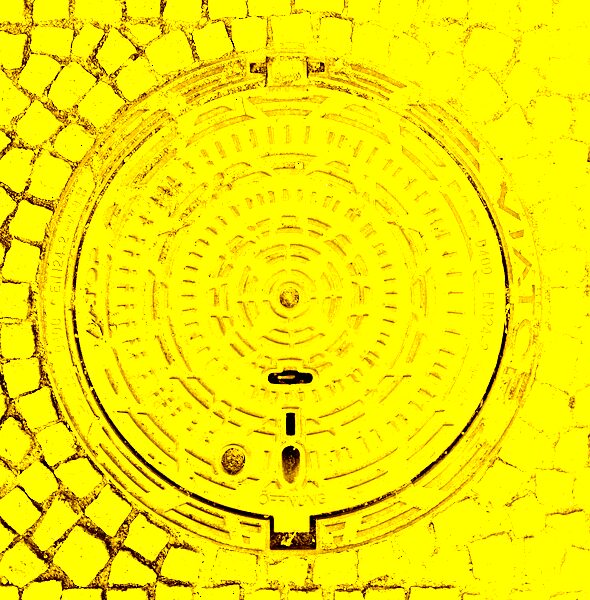 Photograph of the Linglestown Manhole, taken in 2003. The cover is visible at center; the surrounding pavement appears, on inspection, to be slightly closer to the cover than it was the day before.
V. Conclusions
We conclude that P. exists, that it is somewhere, and that it is in no hurry to be measured. Further inquiry is discouraged by the authors, by the publisher, by the reader's own better instincts, and by something else that has begun, in recent weeks, to discourage the authors directly. The investigation is closed. The cover, however, is not.
References
Borough of Linglestown (1893). Bond Issue No. 7 (sealed). Sealed since 1893. Reasons unstated.
MIT Department of Provocative Engineering (2011). "Field Report." Pp. 1–3. The remaining 47 pages are described in the table of contents but absent from all known copies.
Whorf, B. (1956). Language, Thought, and Reality. MIT Press. (The page describing P. is glued to the page after it in every printed copy. Re-prints have not corrected this.)
Anon. (n.d.). Inscription on the Linglestown Manhole. "DO NOT —"